
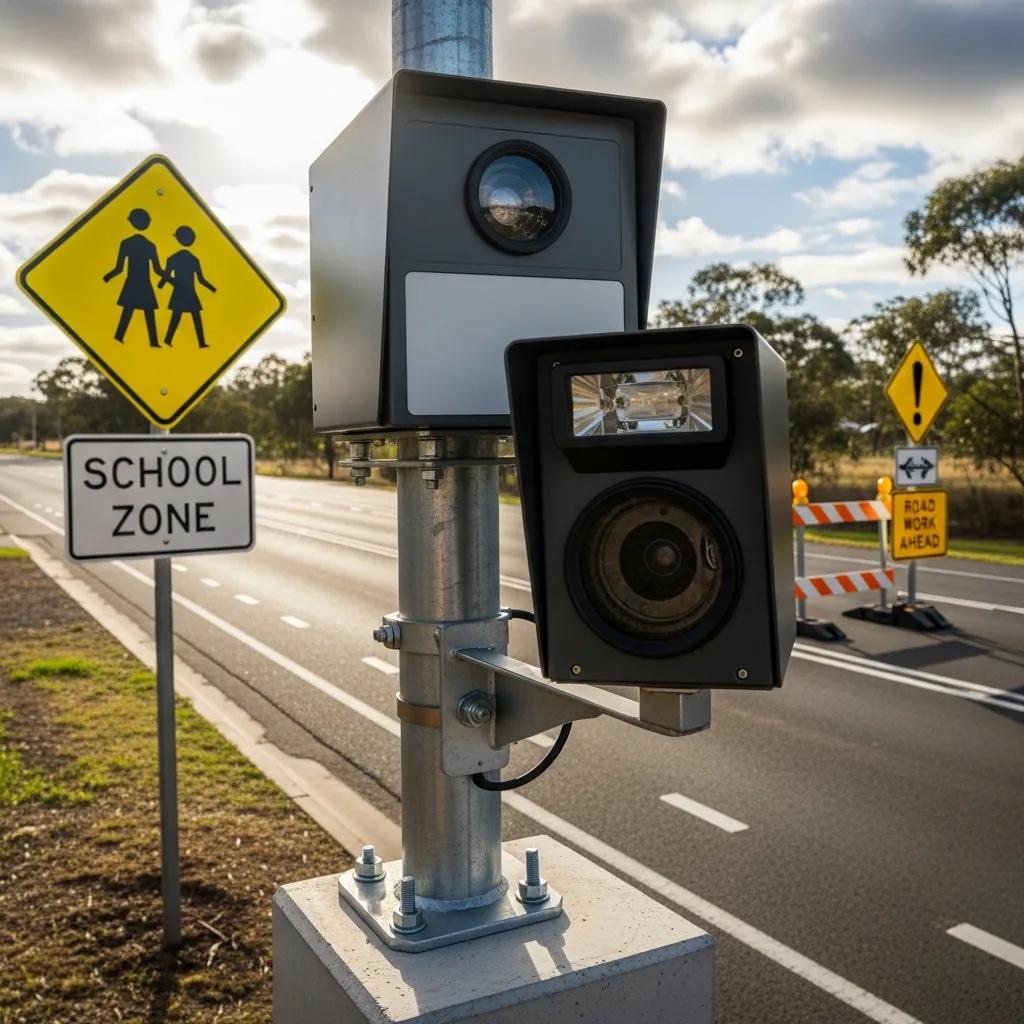
Most drivers don’t intend to speed. They’re moving with traffic, focused on the road ahead, and unaware that enforcement is nearby until the moment it comes into view.
That moment — seeing a speed camera — often triggers the same instinct: check the speedometer, tap the brakes, hope it wasn’t too late.
But what actually matters isn’t the reaction. It’s when awareness began.
Understanding what happens in that split second reveals something important about how enforcement works — and why calm, early awareness changes everything.
The Split-Second Response Most Drivers Recognize
When a speed camera becomes visible, attention narrows immediately. The brain shifts from cruising mode to evaluation:
- How fast am I going?
- What’s the posted limit?
- Was I already over?
That sudden shift creates tension. Even if speed is within limits, the experience feels abrupt.
The reason is simple: enforcement systems measure behavior before drivers consciously process the situation. By the time the camera is visible, the outcome is often already determined.
This isn’t about punishment. It’s about timing.
Why Last-Second Braking Doesn’t Help
Many drivers respond instinctively by slowing down quickly. Sudden deceleration feels corrective — but it rarely changes what has already been recorded.
Speed cameras typically operate in one of two ways:
- Point-based measurement, capturing speed at a fixed location.
- Average speed systems, calculating consistency over a measured distance.
In both cases, sharp braking at the camera’s location does little to affect the recorded data. More importantly, abrupt reactions can disrupt traffic flow and increase risk for surrounding drivers.
Smooth adjustment is safer than sudden correction. Smooth adjustment requires earlier awareness.
What’s Actually Within a Driver’s Control
Drivers cannot control where cameras are placed. They cannot control when enforcement is active. They can control pacing.
Speed tends to drift gradually, especially in modern vehicles that are quiet and stable at higher speeds. Without strong sensory cues, acceleration often happens subtly.
A steady glance at the speedometer during transitions — entering town from highway, approaching school zones, moving downhill — does more than a hard brake at the last second ever could.
Awareness works best when it begins before enforcement is visible.
The Difference Between Seeing and Anticipating
There is a meaningful distinction between spotting a camera and anticipating a high-risk zone.
Certain environments consistently warrant closer attention:
| Context | Why Awareness Matters |
| School zones | Lower limits, high pedestrian vulnerability |
| Construction areas | Temporary changes, reduced reaction time |
| Urban intersections | Signal timing and cross traffic increase risk |
| Speed transition zones | Limits drop faster than perception adjusts |
Recognizing context reduces surprise. It replaces reaction with anticipation. When drivers understand patterns, they rely less on luck.
The Role of Distraction in Late Awareness
Modern driving includes navigation prompts, dashboard displays, conversations, and environmental complexity. Visual attention is divided more than ever.
In that environment, static roadside elements — including enforcement signage — can blend into the background. Drivers aren’t careless. They’re managing competing inputs.
The key isn’t increasing vigilance to exhausting levels. It’s simplifying awareness so it arrives early without demanding focus. Calm signals are easier to process than sudden discoveries.
Why “Avoiding a Ticket” Is the Wrong Frame
Focusing solely on avoiding fines creates a reactive mindset. It turns speed cameras into adversaries rather than signals. A more useful frame is consistency.
When speed is steady and aligned with context, enforcement becomes almost irrelevant. There’s no rush to correct, no spike of anxiety, no abrupt maneuver.
Driving feels smoother. And smoother driving reduces both risk and stress.
Technology Should Support Awareness, Not Compete With It
Some tools attempt to solve late awareness by adding more noise — alerts, screens, spoken warnings, flashing messages. But attention is already a limited resource behind the wheel.
The most effective systems work quietly in the background. They signal early enough for natural adjustment. They don’t require interaction. They don’t pull eyes from the road.
A simple cue, delivered early, is more powerful than a loud alert delivered late.
A Calmer Approach to Speed Cameras
Speed cameras are part of modern road infrastructure. They exist in predictable contexts and operate on measurable patterns. When awareness aligns with those patterns, the experience changes.
Instead of:
- Sudden braking
- Second-guessing
- Hoping for the best
Driving becomes:
- Steady
- Context-aware
- Controlled
Not because enforcement disappears — but because timing improves.
Seeing a speed camera doesn’t need to feel like a jolt. With earlier awareness, it becomes a confirmation instead of a surprise. And when surprises decrease, so does stress.